
From the clubhouse
Padel Positions in Doubles: Who Stands Where (and When to Switch)
 Jamie Holt14 May 2026
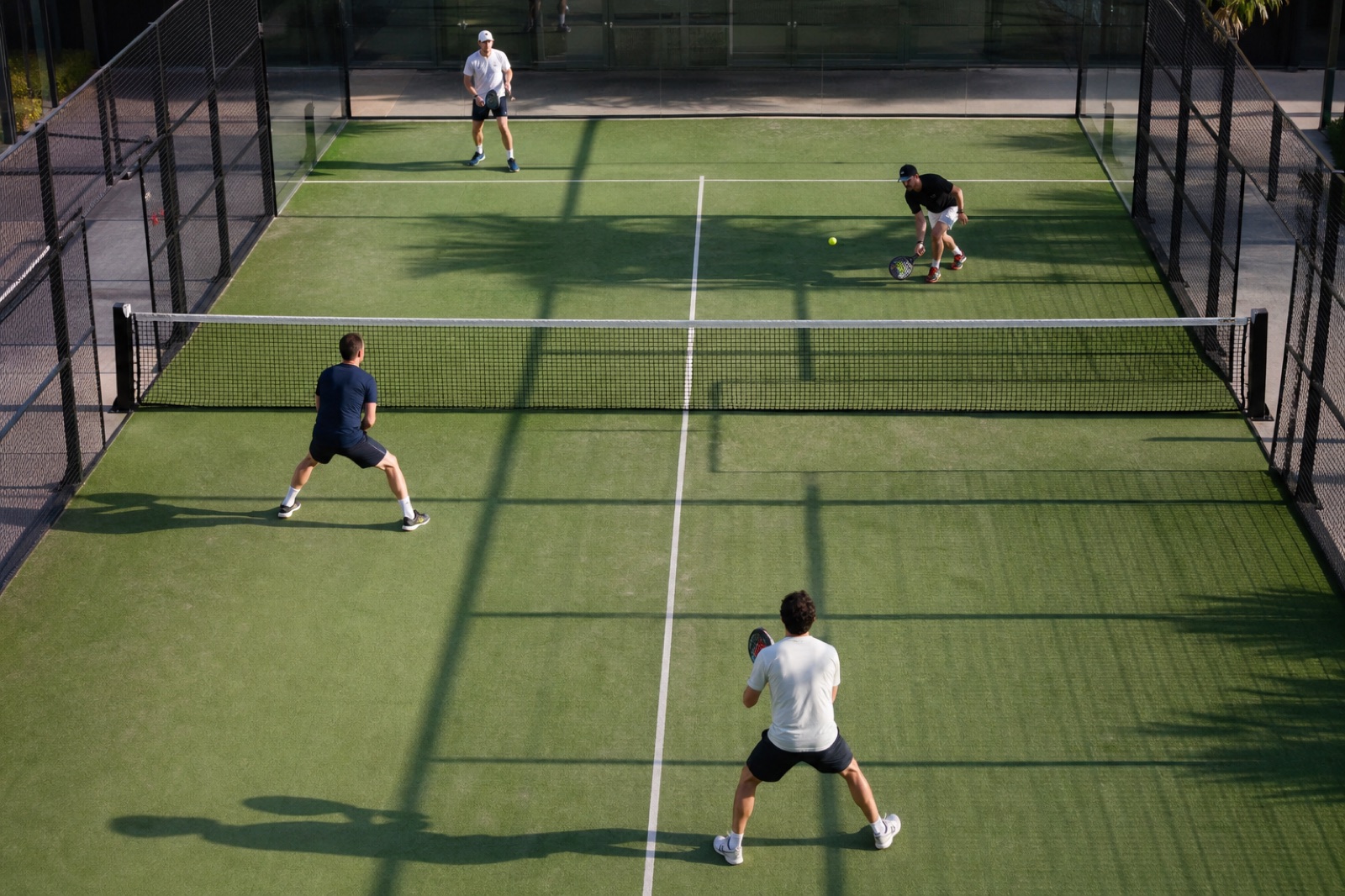
Padel is doubles by default. Four people, one small court, and somehow everyone ends up in the same spot watching the same ball.
Positioning is simpler than it looks. One player at the net, one at the baseline, split the court diagonally, switch when a lob forces it. The rest is repetition.
The basic shape
You're not standing parallel like tennis doubles at Wimbledon. Padel pairs are staggered: front and back.
Net player sits just behind the service line, ready to volley.
Baseline player hangs two to three metres behind the service line, reading lobs and glass.
Net player's job: cut off volleys, punish short balls. Watch for lobs over your head.
Baseline player's job: glass rebounds, defensive lobs. Watch for balls dying at the net.
Left vs right
No strict rule for beginners, but clubs often say right side means forehand toward the middle (more balls through the centre), left side means backhand toward the middle (more balls to the side wall).
Try both in your first ten sessions. Some people naturally prefer one side. Social Americanos force you to practise both anyway.
Who covers what
Down the middle: Usually whoever's forehand (or stronger shot) faces the ball. Call early.
Lobs: Baseline player owns deep balls. Net player tracks backward only if partner is beaten. "Mine" or "yours."
Short balls at the net: Net player steps in. Baseline holds depth unless partner is pulled wide.
Glass at the back: Baseline lets it rebound, then plays. Net player holds position unless switching.
When to switch
A lob over the net player's head → net player becomes baseline → switch.
Ball down the line pulls baseline player wide → partner slides across → may switch.
Call "switch" or "stay" the moment you see the lob. Silence causes collisions. I've seen two people go for the same ball more times than I can count because nobody called it.
Advanced pairs switch fluidly. Beginners: agree one signal in the warm-up and stick to it.
Both at the net
Only when you've pushed both opponents deep, you control the point, and you're ready to retreat if they lob.
Camping double-net without pressure is how you lose 6–0 in eight minutes. Don't do it.
Common mistakes
Two at baseline. No pressure. Opponents dominate the net.
Two at net. One lob, both scrambling backward.
Net player too close. Balls at the feet, and desperate volleys into the net.
No communication. See 15 beginner mistakes.
Serving and returning
Serving team: server at baseline, partner at net on the same side.
Returning team: one at baseline to return, one at net to attack weak replies.
After the return, formation settles into net/baseline stagger within two shots.
Spend one session focusing only on calls: mine, yours, switch. Spend another where the net player doesn't retreat past the service line unless lobbed. Watch one rally replay on YouTube and notice the stagger, not parallel lines. For a short positioning or tactics session tailored to your level, try our free AI padel coach.
Doubles scoring and serve rotation. How to play padel. Find a court and test it.